First things first, tell us a little bit about yourself?
Hello! At the heart of everything I’m a music lover, and over the years that’s manifested into numerous things. I’m a music journalist for The Music by day, and in my spare time I’m a musician (both in a band called Dental Plan and solo as Cheap Domestic); I’m the host of a music interview podcast called Trusty Chords; I manage a two-piece rock band called Echo Social Club; and I also lecture over at Melbourne’s Box Hill Institute. Alongside that, you can also find me collecting records and CDs, and going to gigs whenever possible.
How does it feel to call yourself an author now?
It’s one of the strangest experiences I’ve had in a long time, to be quite honest! I’m a voracious reader, and much like when I first became a journalist with published words out in the world, it felt a little surreal to occupy this role which felt unattainable, or was otherwise occupied by those I admired or deemed to be ‘better’ than me. It’s incredibly odd, though. After years of people joking about my music writing one day resulting in me writing a book, it’s weird to walk into a book store and occasionally see my own name on the shelf.
For those who may not know about the 33 1/3 series, please give us a brief introduction and how you became the Australian author for the Oceania edition.
Sure! So, the 33⅓ series launched back in 2003, and the gist of it is that each volume sees an author (who may be a journalist, a respected writer, or even a musician themselves) penning a lengthy essay on a specific album. Some of them have been very analytical, some of them have been very fun, and there’s even a rare instance of one (a volume on Black Sabbath’s Master Of Reality by my own idol, John Darnielle) being a fictional story.
I’ve adored these books for years and have built a strong collection of them. Along the way though, I thought I’d like to try my hand at writing one, so at the start of lockdown, I submitted a proposal for a book for the ‘global’ edition of the series. It was ostensibly rejected (I never heard back, so I assume it was rejected and they’re not still waiting for me to submit a manuscript…), so I didn’t give it a second thought.
In 2022, however, they launched the Oceania edition, and it just so happened that was the year that TISM had reformed. Figuring it would be a great way to exercise my musical knowledge (read: obsessive fanaticism) of the band, I reached out via the publisher’s website to the facilitators of the Australian edition, inquired about penning a volume, and it sort of snowballed from there.
Why did you choose Machiavelli and the Four Seasons as the focus of your 33 1/3 entry?
There’s a few reasons, actually. Firstly, TISM are a band I’ve been a fan of for decades now. I’ve joked for years that I got into them on the day they broke up in 2004, though despite knowing of them at this point, it was a few months later that I began my fanaticism. Given my approach to bands I love, I immersed myself in their discography, in their still-surviving fan community (shout out to the Victims Of TISM Support Group), and in the process of collecting their recorded output.
Over the years, I simply realised that my knowledge of the group is probably only eclipsed by a few other fans out there, and I figured if I was going to put my efforts into writing anything lengthier, TISM would be a great start.
The second reason is that TISM had actually announced their reunion in 2022, and I’d always said I’d be front and centre for their first reunion show if it ever happened (which, by 2022, was about 18 years beyond something any of us fans thought would ever happen). However, I’d planned to visit my in-laws in the US ahead of the tour, completely neglecting TISM’s penchant for playing secret warm-up shows.
Thus, as I woke up in rural Oklahoma in November 2022, seeing close friends of mine sharing photos and videos of TISM’s first show in 18 years, I was beyond disappointed to have missed it, but I realised that this return would see so many new eyes on the band – all of them question the return and ultimately discounting them as a ‘joke band’ in Australia’s musical history. I figured I could use this disappointment as inspiration to craft something tangible about the band’s history and to write something that would dispel any of these lazy takes on the group’s history by showing how much of an impact on the Australian music scene they actually made.
Lastly, Machiavelli and the Four Seasons isn’t actually my favourite TISM album, but I realised it was the one that was the most popular commercially, and also resulted in the best opportunity for stories from the band’s history. And who doesn’t love a good story?
What do you think makes Machiavelli stand out within TISM’s musical catalogue, or even within ’90s Australian music?
(First Australian band to have 2 songs voted into the Hottest 100.)
I mention in the book that it’s hard to work out if Machiavelli was the album where TISM leaned into electronic music, or if it was the album where they managed to make electronic music work for them in the musical climate of the era. I’ve long believed it was an album that exists as the result of a band writing the right songs at the right time in the right place.
They’d managed to hit upon a formula for writing great songs, their music was informed by and suited for the electronic genres of the era, and their reach and potential was greatly helped by the influence of triple j and the station’s now-national reach. In fact, they became the first band to have two songs in the top ten of triple j’s then-burgeoning Hottest 100 countdown, too.
TISM weren’t the only band to blend humour in with their music, but I’d say that at the time, they were a breath of fresh air, being one of the only bands to do it in a way that appealed to both highbrow and lowbrow sensibilities, thereby broadening their audiences and playing to both ends of the spectrum.
But to me, Machiavelli stands out because it’s this snapshot of a band who had already turned heads a bit, suddenly making the whole country raise a collective eyebrow in confusion thanks to this mesmerising mix of electronic music, pub-rock aesthetic, surrealism, humour, satire, and a dedication to bring it all together in a satisfying, arresting manner. There weren’t any other bands like TISM at the time, and Machiavelli was the peak of this era.
How many shows did you attend while researching and writing the book? Could you name a favourite?
By the time my proposal was accepted, I’d already caught TISM five times during their first run of reunion shows. Funnily enough though, only one of their shows occurred during the writing and researching period. But I also caught them three times around the country last year during their Death To Art tour, which was after I’d announced the book.
For the sake of argument though, I’ll say they all took place during the writing process, and I would say their ‘secret’ performance at 170 Russell in Melbourne on November 26th, 2022 was the best I’d seen. The band felt like they were at the peak for their early reunion shows, the energy was insane, and it was just an experience I won’t forget. Fans also edited together a live video of all the footage taken at the show, and given I was front row, I showed up quite a bit.
Their appearance at Brisbane’s Good Things festival that same year was also great. Considering that we weren’t sure if more shows would actually take place, it felt like it served as a great send-off.
Can you tell us any fun memories from writing the book?
Any TISM fan will tell you that there are many stories of interviews with members of the band which are famous for eclectic requirements, such as getting a journalist to show up wearing a wetsuit at a St Kilda restaurant, for example. I was lucky enough to speak to a few members of the band in an off the record manner so as to firm up and confirm details about what I was talking about at certain points. One member jokingly said he’d meet me for coffee one morning, but he’d only talk if I showed up in a wetsuit. Though I was fairly certain he was joking, I briefly considered purchasing one before realising it was supposed to be 40 degrees on the day we were meeting up.
Another memory is one I’m most proud of from a journalistic point of view surrounding the book. Put simply, TISM’s biggest single – (He’ll Never Be An) Ol’ Man River – ruffled a few feathers due to its perceived insensitivity regarding the death of actor River Phoenix. One example was Flea, the Australian-born Red Hot Chili Peppers bassist who was with Phoenix the night he died.
Well, in 1996, Flea gave an interview with triple j and during the chat, he – apropos of nothing – started talking about how much he hated TISM and how he wanted to fight them. For years, fans had spoken about this audio, but no one had a recording. It’s mentioned everywhere online – even TISM referenced it in interviews – but it didn’t seem to exist anywhere. Countless fans have said they remember it, but couldn’t give any details.
As part of my research, I had to go down a lot of rabbitholes, including working out when that interview happened, who Flea was speaking to, etc. Anyway, I ended up reaching out to the ABC and somehow managed to track down that very audio, which appeared to have been lost for decades. It was a little surreal to listen to, to be honest.
What cultural legacy do you believe this album has carried through the decades?
Frankly, it’s hard to think of alternative music from the ’90s without paying mind to TISM. Their impact on the Australian music scene is undeniable, and I think they really helped to tell music lovers that you don’t need to take yourself seriously. That it’s okay to let go, have fun, and let the bizarre aspects of Australian culture be satirised through music.
It’s also hard not to see a lot of bands that have a tongue-in-cheek aspect to their music not being influenced by TISM in some way. I think the legacy of this album is that it helped allow music fans to have a bit more fun, to open themselves up to lyrics which were a bit more pointed and thought-provoking, and to also just remember that music doesn’t need to be serious all the time.
Now to Records, are you much of a collector (outside of TISM of course)?
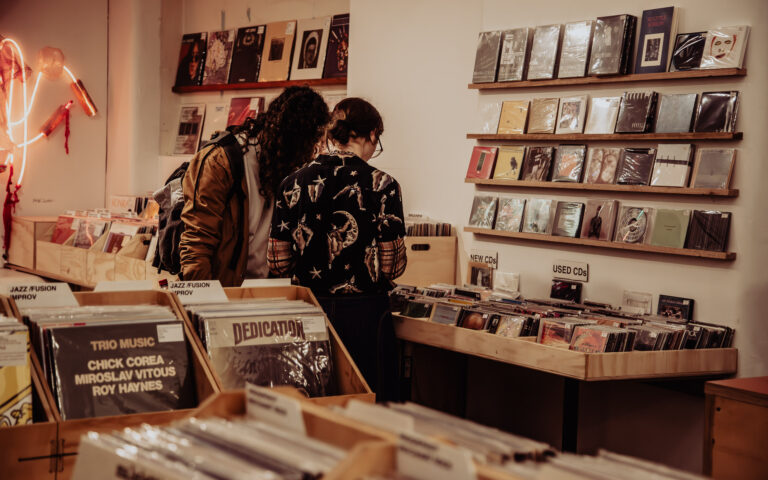
Oh, absolutely. My first love of music collecting was CDs, but records swiftly took over. I think my records number well into the thousands now, thanks largely to bands like TISM, Private Function, and others who I collect voraciously. During COVID, I launched a TikTok account where I was just sharing cool records from my collection, and it was always so fun to share stories about artists playing with the format, delivering unique colours, or releasing surprising pressing variants.
I remember needing to constantly defend my love of physical media when I was younger, especially in regard to why I’d desire buying a new album when I could listen to it online. But there’s nothing like the amount of love, dedication, and care put into the process of pressing a record, making it look good, and then eventually letting the listener drop the needle a couple of hundred times.
Can you remember the first ever record you bought on vinyl?
I can, actually! I grew up around records and always admired them, but it took my years to actually properly curate a vinyl collection due to the cost barrier and a longtime preference of CDs. However, I took a trip down to Adelaide one day to buy a copy of Godspeed You! Black Emperor’s F♯ A♯ ∞, and it all kicked off from there. One of my all-time favourite records, this was actually the album I wrote my initial 33⅓ proposal for.
Originally from Adelaide, do you have a favourite store from your home city?
Without a doubt, it’s Clarity Records. I’m undoubtedly biased since I love a good hometown record store (so a big shout out to Oklahoma City’s Guestroom Records, too, since it was my local for a while), but Clarity Records deserves to be mentioned in the list of best stores worldwide. Not only have Footy and Laura crafted something truly amazing in terms of a store that is warm, welcoming, and aesthetically-pleasing, but it’s a massive task to curate a store which manages to both be accessible from a genre point of view, but also catering to specific tastes as well. It’s a fine line to walk, and they do it (seemingly) effortlessly.
And a Melbourne favourite?
Melbourne has so many great stores that it’s hard to pick. On the TISM front, I’d have to mention Greville Records, given that there’s some links in the chains in the band’s history, and the mere fact that Greville is a stellar place for any music fan to visit. Rocksteady Records in the CBD is a favourite, because if you’re ever going to visit a record store, you definitely want someone like Pat at the helm. I also love Oh! Jean in Fitzroy because the vibe that Zach has curated there is unlike anything else in the city. Also a shout out to Goldmine Records (the only place who has made it possible to fill out my Throbbing Gristle collection), Happy Valley Shop, and Northside Records.
Where can we get our hands on your new book?
You can definitely try your luck at bookstores around Melbourne (I’ve pointed folks to Paperback Bookshop, and Readings in Carlton since they’re some of my favourites and have previously had it in stock), but the most reliable option is probably the Bloomsbury website, since they’re the publisher, they likely remain the best source!